

The short answer
Most people with a herniated disc in the lower back notice a clear change within two to six weeks. Full activity often comes back from about three months. About 9 in 10 people with a herniated disc and sciatica get better without surgery. About 2 in 3 feel some improvement in the first two weeks. Recovery tends to move through four phases, set out below.
Starting the right physical therapy early can get you better faster. In a Salt Lake City trial of adults with recent sciatica, those sent straight to physical therapy did better than those given advice alone: 45% rated their treatment a success at one year, compared with 28%. Request a Free Case Review
Why not just wait it out?
Sciatica often eases with time, but not quickly for everyone: 20 to 30% of people still have problems one to two years later. In a Salt Lake City trial, 45% of people who started physical therapy right away rated their care a success a year later, compared with 28% of people given advice alone. Quick relief is our first goal. At your first visit we look for the movement or position that eases your leg pain, and most of our patients notice improvement after their first visit. Often that means less pain before you leave, even in really challenging cases. Leg weakness that is getting worse, numbness between the legs, or new bladder or bowel trouble needs emergency care, not an appointment.
Book a Free Case Review if:
- You want relief now, not in a few weeks
- Your leg pain is not clearly easing after a few days
- It keeps coming back
- It is costing you sleep, work or time with family
Request a Free Case Review Expect a call or text the same day.
About 9 in 10 people with a herniated disc and sciatica get better without surgery (AANS, 2024; NASS patient guide; Vroomen, NEJM, 1999). Improvement usually starts within weeks: about two thirds of people report feeling better by 2 weeks, and 87% by 12 weeks (Vroomen, NEJM, 1999). The disc itself often shrinks over the following months, and the right movement and training can improve your recovery.
The herniations that look worst on a scan are the most likely to shrink. Loose fragments (sequestrations) got smaller without surgery in 96% of cases, and extrusions in 70% (Chiu, Clinical Rehabilitation, 2015).
Most people with a new bout of sciatica have a favorable outlook (Koes, BMJ, 2007). Getting assessed early gives you a plan from the start.
This guide covers herniated disc recovery time for the low back, managed without surgery. After an operation, follow your surgical team’s instructions and see our back-surgery recovery guide.
Do not wait on a timeline for warning signs. New bladder or bowel control changes, inability to urinate, numbness around the genitals or anus, or symptoms in both legs need emergency care. New or worsening leg weakness needs prompt medical assessment. Read the full list.
Find your answer: Timeline by stage · Stages of healing · How physical therapy helps · Signs of improvement · When recovery stalls · Work, running and flare-ups · Choose your next step
Herniated disc recovery time: the key facts
- First easing: About 2 in 3 people feel some improvement within two weeks. By three months it is nearly 9 in 10.
- Clear change: Most people notice it within two to six weeks.
- Back to full activity: Often from about three months, sport and lifting included.
- Emergency signs: New bladder or bowel changes, being unable to pass urine, numbness around your genitals or anus, a new change in sexual function, fast-worsening leg weakness, symptoms in both legs, or back symptoms after a serious accident. Call 911 or go to the emergency room.
Where these numbers come from: Vroomen 1999, AANS.
How long does a herniated disc take to heal?
Most people notice a clear change within 2 to 6 weeks, and full activity often comes back from about three months. The disc usually takes longer: shrinkage on MRI mostly happens within about six months (Zou, Clinical Spine Surgery, 2024).
This is the natural history of lumbar disc herniation: most cases improve without surgery over weeks to months. The North American Spine Society’s guideline group states that the majority of patients improve whatever treatment they receive, and that herniations often shrink over time (Kreiner, The Spine Journal, 2014).
Most people with a herniated disc never need surgery. In two studies that followed people with sciatica for a year, 2% and 14% had an operation (Weber, Spine, 1993; Bush, Spine, 1992).
What about 6 weeks? Six to eight weeks is the usual first checkpoint in conservative treatment, not a deadline (Koes, BMJ, 2007). Improvement commonly continues through 12 weeks and beyond.
What does herniated disc recovery look like week by week?
Recovery usually moves through four phases. Each one has its own job.
| Timeframe | What is usually happening | What you can usually do |
|---|---|---|
| Weeks 1 to 2: calm it down | Sharp pain settles; you find the positions that ease it | Short walks, rest with knees propped, heat or ice |
| Weeks 2 to 6: get moving | Leg pain fades or retreats toward your back | Sit and stand longer; pick up daily tasks again |
| Weeks 6 to 12: build strength | Trunk and hip strength becomes the main job | A full workday, light lifting, longer walks |
| From about 3 months: back to everything | Practice aimed at your own job or sport | Running, heavier lifting and full work, in stages |
These are typical ranges. With physical therapy, many people move through them faster, and you have a plan if progress stalls. Everyone’s recovery is individual, and Dr. Emily adjusts the plan to you.
The turn usually comes between weeks two and six. That is also when it is tempting to stop. Keep going. The strength phase is what helps the progress last.
The stage-by-stage notes below add what to watch for at each point.
Free Case Review
Let’s talk through your questions about getting back to your day.
Leave your name and number. We’ll call or text you back the same day for a free conversation about what is going on and how we can help. If you write in the evening or on a weekend, we’ll reach you the next business day. You don’t need to choose a treatment first.
15 minutes, three answers:
- Is this the kind of problem physical therapy usually helps?
- Are we the right clinic, and if not, who is?
- What will it take: visits, cost and how soon you can start.
Most patients notice improvement after their first visit. It is 60 minutes, one-on-one, and you leave with a written plan and exercises you have already practised.
We take only 1–2 new patients a week, so openings are limited. Back and neck pain appointments are usually available in under 72 hours. Ask about Fast Track and package pricing.
Local or virtual: In-person PT in Holladay, serving Greater Salt Lake City. Virtual health and wellness coaching is available from anywhere.
Your free case review can happen by phone or video.
Herniated disc recovery timeline, stage by stage
These stages describe what people commonly notice. Your own pace may be faster or slower.
The first week
What people commonly notice: this is often the hardest stretch, and many people feel the first easing before the second week is out. For most people it gets better from here.
What helps: stay as active as your symptoms allow, and change position often. Short rests for relief are fine.
When to get reviewed: straight away for any warning sign. Otherwise, you can ask for an assessment whenever you want a plan. You do not have to wait.
Weeks 2 to 6
What people commonly notice: leg pain becomes less frequent or less intense. Sitting, walking and sleep get easier. About two thirds of people report improvement by 2 weeks (Vroomen, NEJM, 1999) and about three quarters by 4 weeks (Koes, BMJ, 2007). Good and bad days are normal, so watch the trend.
What helps: building walking, sitting and daily tasks in small steps, with exercises matched to how your symptoms respond. See our McKenzie exercise guide.
When to get reviewed: if you see no useful trend after a few weeks, or symptoms are spreading.
Weeks 6 to 12
What people commonly notice: daily activities are easier, and remaining leg or back symptoms keep fading. By 12 weeks, 87% of people report improvement (Vroomen, NEJM, 1999).
What helps: graded strength and activity, aimed at the tasks you want back.
When to get reviewed: if leg pain still limits you, ask for a clear plan and a review of your options.
From about 3 months
What people commonly notice: steady gains in what you can do, and a return to exercise and sport. In one spine-clinic study, leg pain went away completely in 81% of people treated without surgery, taking six months on average (Suri, Archives of Physical Medicine and Rehabilitation, 2012).
What helps: building toward your own goals, with a plan for flares.
When to get reviewed: if sitting, walking, sleep or work is still substantially limited at about three months.
What should you do in each phase of recovery?
These are common starting points, one for each phase. Add the next one when the current one feels easy. Dr. Emily may start any of them sooner.
Get assessed first if you have leg weakness, spreading numbness, a recent injury or spinal surgery, or osteoporosis, or you are pregnant. Emergency signs mean the emergency room, not exercises.
Weeks 1 to 2: walking (5 to 10 minutes, 2 or 3 times a day)
- Choose level ground and an easy pace.
- Keep your steps relaxed and let your arms swing.
- Add a few minutes as it gets easier.
Why it helps: gentle activity serves you better than bed rest. Stop if: leg pain builds.
Between walks, lie on your back with your knees propped on pillows whenever you need relief.
Weeks 2 to 6: press-up (10 slow reps, hold 2 to 3 seconds at the top)
- Lie face down with your hands under your shoulders.
- Press up through your arms. Your hips stay on the floor.
- Pause at the top, then lower slowly.
Why it helps: bending backward eases leg pain for many people. Stop if: pain travels farther down your leg.
Weeks 6 to 12: bird-dog (hold 5 to 10 seconds, 8 to 12 times each side)
- Start on hands and knees.
- Slide one arm forward and the opposite leg back.
- Keep your back level. Hold, lower, then change sides.
Why it helps: it builds the control you need for lifting and long days. Stop if: your back twists or leg pain returns.
From about 3 months: your own job or sport
Now you practice the real thing in small steps: the lift, the run, the long drive. Start below what you think you can manage, and add a little each week. Step back a stage if: leg symptoms return.
What does a good response feel like?
Leg symptoms ease or move up toward your back, and walking feels easier afterward. Get assessed if pain spreads down your leg, or new numbness or weakness appears.
What should wait, and until when?
- Bed rest: a day or two at most.
- Crunches, sit-ups and toe touches: until your leg symptoms have settled. Curling forward often stirs them up.
- Heavy deadlifts and squats, and loaded twisting: until the strength phase, once your therapist clears you.
- Running and jumping: usually the last to return, from about three months.
Rule of thumb: if it leaves leg symptoms worse or farther down afterward, it is wrong for now.
The full six-exercise plan is on our herniated disc treatment page.
Stages of herniated disc healing
Here is how a herniated disc heals. The three stages overlap, and the timing varies from person to person.
- Inflammation (early). The body reacts to the displaced disc material. This is the painful part, and it also appears to be how the body starts clearing the material (Cunha, Arthritis Research and Therapy, 2018).
- Resorption (over the following weeks and months). The fragment loses water and shrinks. New blood vessels grow at its edge, and immune cells called macrophages break it down.
- Remodeling (over months to a year or more). Shrinkage can continue while symptoms settle and strength returns.
Herniated disc resorption time by disc type
Scan reports use four types, sometimes called the stages of disc herniation. The more dramatic the type, the more often it shrinks (Chiu, Clinical Rehabilitation, 2015).
| Type | What it means | Shrank on repeat MRI |
|---|---|---|
| Bulge | Broad, shallow extension of the disc | Changes least; people feel better anyway |
| Protrusion | Herniation with a wide base | 41% |
| Extrusion | Material pushed through the outer ring | 70% |
| Sequestration | A fragment separated from the disc | 96% |
Sequestrations disappeared completely in 43% of cases, and extrusions in 15%. Across all types, about two thirds of herniations shrink (Zhong, Pain Physician, 2017). Shrinkage can show on a scan by two months (Autio, Spine, 2006) and mostly happens within six months (Zou, Clinical Spine Surgery, 2024).
Does feeling better mean the disc has healed?
You do not need a clean scan to feel better. Leg pain often eases before the scan changes (Komori, Spine, 1996). At one year, a herniation was still visible in about a third of people who had recovered (el Barzouhi, NEJM, 2013). So we follow your pain, strength, sensation and daily tasks, not the image alone.
Our disc-healing guide explains MRI shrinkage by disc type. You can also read what to ask after a herniated-disc MRI.
Watch Dr. Emily discuss whether disc herniations can heal
Watch Dr. Emily discuss disc recovery on YouTube.
Physical therapy for a herniated disc: movement improves the odds
You do not have to sit and wait for a disc to heal. Active care improves results.
- Starting physical therapy early works. In a Salt Lake City trial of 220 adults with recent sciatica, people sent straight to physical therapy were clearly more likely to rate their treatment a success a year later than those given education alone. Their disability scores were also better at six months. The therapy was four weeks of exercise and hands-on care (Fritz, Annals of Internal Medicine, 2021).
- Exercises matched to you work better. Three out of four people with back pain had a direction of movement that eased their symptoms. Those given exercises in that direction improved more on every measure within two weeks than those given other exercises (Long, Spine, 2004).
- Centralization is a good sign. When leg pain retreats toward the spine during movement testing, the outlook is better: 3 of 25 such people went on to surgery, compared with 16 of 35 whose pain did not centralize (Skytte, Spine, 2005).
- Combined care helped people on a surgical waiting list avoid the operation. About 2 in 3 who had McKenzie-based therapy plus steroid injections did not have the operation, compared with about 1 in 4 of those who simply waited (Mutubuki, The Spine Journal, 2025).
- Severe sciatica responds too. People with sciatica severe enough to qualify for surgery made clinically important improvements with about five sessions of active treatment (Albert and Manniche, Spine, 2012).
What else helps herniated disc recovery?
- Getting help sooner. People treated within six months of their symptoms starting improved more than those treated later (Rihn, Journal of Bone and Joint Surgery, 2011).
- Expecting to improve. People who believed their problem would last a long time were less likely to improve (Konstantinou, The Spine Journal, 2018). Clear information is part of treatment.
- Staying active as symptoms allow.
How Dr. Emily helps
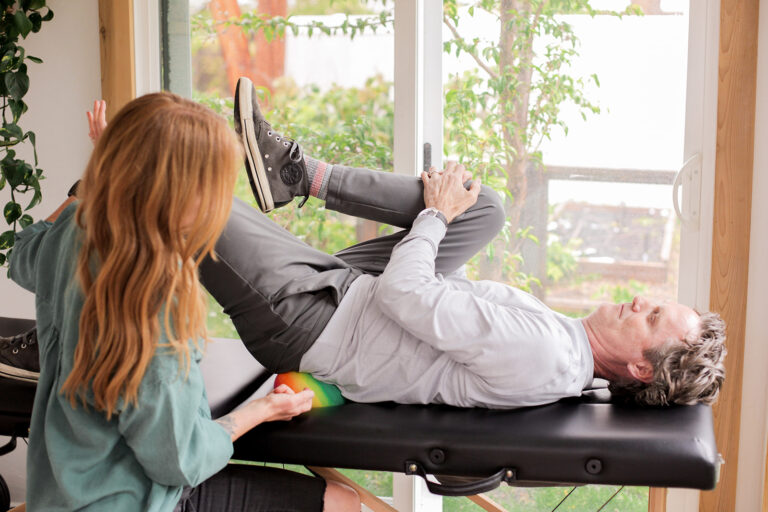
Dr. Emily Warren, DPT, Cert. MDT, listens to the story behind the scan report. She checks your movement response and relevant nerve findings, then practices a starting plan with you. When the examination finds a movement direction that helps, her McKenzie training guides the exercises. Care also includes manual therapy when appropriate, graded strength and activity, pain education and a flare-up plan.

Explore individual disc-related PT or sciatica care.
Watch Dr. Emily explain pain and imaging
Dr. Emily uses an overflowing-cup analogy: imaging findings, activity, sleep, stress and sensitivity can all add to pain. Watch Dr. Emily explain pain and imaging on YouTube.
Google review: Rachael C.
“Having her support has made my situation feel less scary.”
What are signs a herniated disc is healing?
Signs a herniated disc is healing include less frequent leg pain, leg pain retreating toward the back, easier sitting or walking, better sleep and stable or improving strength. Look for a trend over several days, not one pain-free hour.
| What to track | A useful sign of progress | When to review the plan |
|---|---|---|
| Sitting and walking | You can do a little more of the same task with a manageable response afterward. | The same small task repeatedly stops you, or symptoms are worsening. |
| Sleep and daily activity | Sleep is less interrupted, or dressing, work and household tasks are becoming easier. | Pain keeps disrupting normal activities despite following the plan. |
| Leg symptoms | Leg pain or tingling is less frequent or less intense. | Symptoms spread, numbness changes, or leg function deteriorates. Tell your clinician. |
| Strength and sensation | Your clinician finds stable or improving function alongside your activity progress. | New or worsening weakness needs prompt medical assessment, even if pain is easing. |
Choose one task that matters to you and record how you felt that evening and the next morning. Our back-pain progress tracker can help.
What if recovery is taking longer than expected?
A slow start does not mean a poor finish. It means the plan deserves a review. Arrange one if symptoms are not improving after a few weeks, and sooner if they worsen.
- Some things are improving, but one task is stuck: bring that task to your therapist. Review the movement, the amount and the activity progression.
- Little improvement after several weeks: revisit the examination, strength and sensation, the diagnosis, and whether medical evaluation would change the plan.
- Still substantially limited after about three months: discuss medical reassessment and your options. This does not automatically mean surgery.
Ask what has changed since your first examination, and what will be adjusted next. The PT-not-working guide can help you prepare.
Want a second look at your plan? Request a Free Case Review with Dr. Emily.
Google review: Kim P.
“She quickly identified my back and leg issues within just a few appointments, leading to immediate improvements in my condition.”
How does recovery compare with surgery?
By one to two years, results are similar for most people. Surgery tends to bring faster early relief.
| Question | Non-surgical care, including PT | Surgery (microdiscectomy) |
|---|---|---|
| How soon relief comes | Builds over weeks, usually 2 to 6 | Leg pain often eases quickly |
| Limits while you recover | None fixed; you stay active | About 4 to 6 weeks of restrictions |
| Back to full activity | Often from about 3 months | About 3 to 6 months, rehab included |
| How people feel at 1 to 2 years | Similar for most people | Similar for most people |
A surgical opinion is reasonable if leg pain is still severe after a steady six to eight weeks of treatment, or you are getting worse while following the plan. The warning signs further down this page always come first. Our guide to back surgery or physical therapy covers the decision.
Where these numbers come from: Jacobs 2011, Koes 2007.
Quick answers about herniated disc recovery time
How long does a herniated disc in the lower back take to recover?
A clear change usually comes within two to six weeks. Full activity often follows from about three months. Most lower-back herniations sit at L4-L5 or L5-S1, and both follow the same four phases.
How soon does physical therapy start to help?
Often within two to six weeks. Many people feel the first easing in the first two weeks.
What are the best herniated disc recovery tips?
Five habits help most people.
- Walk a little, several times a day.
- Change position often. When you sit, stand up every 20 to 30 minutes.
- Start physical therapy early instead of waiting.
- Keep up your home exercises after you feel better, through months three to six.
- Stay generally active, and do not smoke.
When can I lift, run or play sport again?
Often from about three months. Light lifting usually returns during weeks 6 to 12. Running and heavier lifting come back in stages after that.
Can I speed up my recovery?
You can help it along. Starting therapy early, staying active and sticking with the strength work are the things most linked with doing well. The disc itself often shrinks too, on its own schedule. About 7 in 10 get smaller, mostly within six months. Our healing without surgery guide explains how.
Where these numbers come from: Fritz 2021, Zou 2024.
Herniated disc recovery questions
Can a herniated disc heal in a week or two weeks?
You can feel better that fast. About two thirds of people report improvement by 2 weeks (Vroomen, NEJM, 1999). The disc itself takes longer to change on a scan, so build on early relief gradually.
How long does a herniated disc take to heal without treatment, or naturally?
Many people improve over weeks to months, but among people with sciatica, 20 to 30% still have problems a year or two later. The right physical therapy helps many people feel better sooner and know what to do if it flares. In a trial of 183 people with sciatica, 87% reported improvement by 12 weeks. Improved is not the same as pain-free, and about 1 in 8 had not improved after three months (Vroomen, NEJM, 1999). Active care can add to that, as the results above show.
How long does herniated disc pain last?
For most people, the worst of it eases within two to six weeks. In one study, leg pain went away completely in about 8 in 10 people treated without surgery (Suri, Archives of Physical Medicine and Rehabilitation, 2012).
How long does a herniated disc flare-up last?
Most flares settle. Go back to your easing positions and short walks, then build up again. And flares are not the rule: about 3 in 4 people whose leg pain had fully settled stayed free of it for the next year (Suri, Archives of Physical Medicine and Rehabilitation, 2012).
The trend over several days matters more than one bad day. Get reviewed if a flare is not settling, and get prompt medical assessment if it brings new weakness. Our back-pain flare-up guide can help.
How long should I wait to run after a herniated disc?
Use function, not the calendar. Before adding impact, talk with your therapist about your walking tolerance, leg strength and any remaining numbness or weakness. A return plan can move from comfortable walking to short walk-run intervals, then longer running as your response allows.
Many people are running again from about three months, and the research is encouraging. About 8 in 10 elite athletes treated without surgery returned to their sport (Sedrak, Sports Health, 2021).
Can I work while recovering from a herniated disc?
Usually yes, with temporary adjustments. Desk work may need shorter sitting periods. A lifting job may need changes to load or repetition. Bring the real demands of your job to your assessment so you can build toward them.
Should you rest or keep moving?
Keep moving as symptoms allow. Two weeks of bed rest brought no faster recovery than carrying on with watchful waiting (Vroomen, NEJM, 1999), and a Cochrane review found little or no difference between bed rest and staying active (Dahm, Cochrane Database, 2010). Short rests are fine. For symptom-relief options, ask your medical clinician or pharmacist. McKenzie exercises are one approach when your examination supports them.
Can a herniated disc heal after 2 years or 5 years?
Yes, improvement is still possible. People with more than six months of symptoms still improved with treatment (Rihn, Journal of Bone and Joint Surgery, 2011). The gains people make tend to hold after the first year (Peul, BMJ, 2008), and the right plan can still add to them.
By this stage the scan often does not explain the pain. Pain reflects the nervous system’s judgment that protection is needed, not only the state of the tissue (Moseley and Butler, Journal of Pain, 2015). Learning how pain works reduces fear of movement, which makes it easier to get active again (Watson, Journal of Pain, 2019).
Is recovery time different for a bulging, herniated, slipped or ruptured disc?
A bulging disc is a broad, shallow extension and is not classed as a herniation (Fardon, The Spine Journal, 2014). Bulges are often normal: they appear in 30% of pain-free 20-year-olds and 84% of pain-free 80-year-olds (Brinjikji, AJNR, 2015). For bulging disc recovery time, follow your symptoms and the timeline above.
“Slipped disc” and “ruptured disc” are everyday terms, not formal categories. People usually mean a herniated disc (also spelled disk, or called prolapsed). Nothing actually slips out of place. Slipped disc and ruptured disc recovery time follow the same timeline. If your report describes an extrusion or sequestration, those are the types most likely to shrink.
When should you start physical therapy after a herniated disc?
Early. You do not need to wait six weeks. People referred to physical therapy at their first primary-care visit, about five weeks into symptoms on average, did better at one year than those given education alone (Fritz, Annals of Internal Medicine, 2021). You do not need a referral to see us.
Can you speed up disc resorption?
Your body shrinks a herniated disc on its own schedule (Yu, Arthritis Research and Therapy, 2022). What you can speed up is how you feel. The right movement, started early, can help you get back to your life while the disc shrinks.
Which symptoms need urgent attention?
Call 911 (or your local emergency number) or go to the emergency department for:
- new loss of bladder or bowel control, or inability to urinate
- numbness around the genitals or anus
- a new change in sexual function
- pain, numbness or weakness in both legs
- back symptoms after a serious accident
These can be signs of cauda equina syndrome, pressure on the nerves at the base of the spine, where fast treatment protects bladder, bowel and sexual function (Lavy, International Orthopaedics, 2022). Do not wait for a routine consultation.
Get prompt medical assessment for new or worsening leg weakness, such as a foot that drags or a leg that gives way, even if pain is easing. Go the same day if the weakness is severe or getting worse quickly. Do not wait for the next timeline milestone.
Herniated disc care in Holladay, serving Greater Salt Lake City
If you live in the Salt Lake City area, you can meet one-on-one with Dr. Emily at our Holladay clinic, 4890 Highland Dr. Your first appointment is 60 minutes and includes assessment, explanation and a starting plan practiced together. No referral is needed. See what a first visit for back pain physical therapy at our Holladay clinic involves.
Reading from elsewhere? Virtual health and wellness coaching is available from anywhere. Clinical virtual physical therapy is a separate service. See how virtual visits work.
Not ready to talk yet? Organize your symptoms and goals first.
About the clinician: Dr. Emily Warren, DPT, Cert. MDT, owns Mindful Movement Physical Therapy. She is a McKenzie-certified Doctor of Physical Therapy. This guide is general education, not individual advice.
Let’s make your next step clearer
The odds are on your side, and a clear plan improves them. In your Free Case Review, a free phone or video conversation, we listen to what you want back, answer your questions and help you decide whether care with Mindful Movement fits.
Call or text (385) 332-4939.
Sources
- American Association of Neurological Surgeons: Herniated Disc, 2024
- North American Spine Society: Herniated Lumbar Disc, patient guide
- Vroomen, NEJM, 1999: bed rest vs watchful waiting for sciatica
- Koes, BMJ, 2007: diagnosis and treatment of sciatica
- Kreiner, The Spine Journal, 2014: North American Spine Society guideline
- Weber, Spine, 1993: acute sciatica
- Bush, Spine, 1992: sciatica managed without surgery
- Chiu, Clinical Rehabilitation, 2015: regression by disc type
- Zhong, Pain Physician, 2017: incidence of resorption
- Zou, Clinical Spine Surgery, 2024: resorption and timing
- Autio, Spine, 2006: resorption at 2 and 12 months
- Komori, Spine, 1996: MRI change and leg pain
- el Barzouhi, NEJM, 2013: MRI at one year
- Cunha, Arthritis Research and Therapy, 2018: how herniations regress
- Fritz, Annals of Internal Medicine, 2021: early physical therapy for sciatica
- Long, Spine, 2004: matched directional exercises
- Skytte, Spine, 2005: centralization and surgery
- Mutubuki, The Spine Journal, 2025: McKenzie-based therapy plus injections before surgery
- Albert and Manniche, Spine, 2012: active treatment for severe sciatica
- Rihn, Journal of Bone and Joint Surgery, 2011: symptom duration and outcome
- Konstantinou, The Spine Journal, 2018: who improves
- Suri, Archives of Physical Medicine and Rehabilitation, 2012: resolution and recurrence
- Sedrak, Sports Health, 2021: return to play
- Dahm, Cochrane Database, 2010: bed rest vs staying active
- Peul, BMJ, 2008: two-year results
- Moseley and Butler, Journal of Pain, 2015: Explaining Pain
- Watson, Journal of Pain, 2019: pain neuroscience education
- Fardon, The Spine Journal, 2014: lumbar disc nomenclature 2.0
- Brinjikji, AJNR, 2015: imaging findings in people without pain
- Yu, Arthritis Research and Therapy, 2022: resorption review
- Lavy, International Orthopaedics, 2022: cauda equina syndrome