
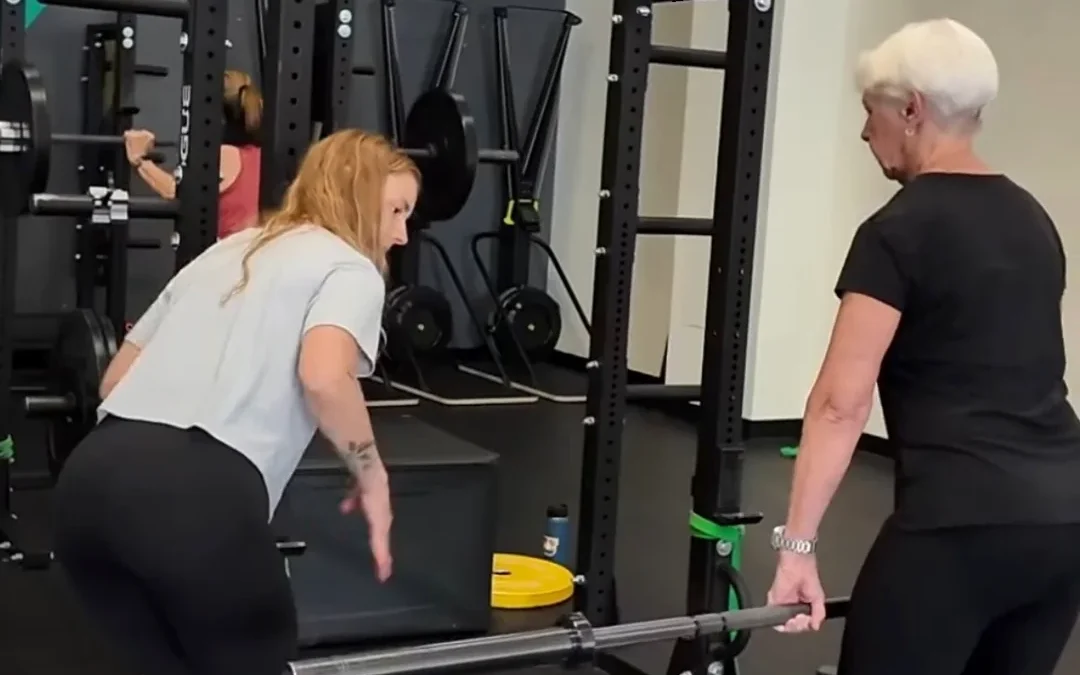
Many people with osteoporosis can build toward more challenging strength training. We start with your experience and health history, teach the movements and help you progress. You do not have to arrive ready for a heavy barbell to take a useful first step.
One-on-one PT with Dr. Emily Warren, DPT, Cert. MDT. No referral needed. In-person care in Holladay, serving Greater Salt Lake City, and virtual coaching from anywhere.
If you have been told both “lift weights” and “be careful,” the missing piece is often a plan that explains what those instructions mean for you.
Google review: Elizabeth W.
“She is very hands on and ensures form is correct, she teaches, and modifies where necessary.”
That is the experience we want to offer: a place to ask questions, practice a movement and understand what comes next. You do not need to be an experienced lifter before asking for help.
What does the research say about heavy lifting?
Supervised high-intensity resistance and impact training raised spine bone density by 2.9% in eight months in postmenopausal women with low bone mass, while the comparison group lost 1.2% (Watson, Journal of Bone and Mineral Research, 2018). The women were screened first and closely supervised, and that is how we approach it too. Heavy lifting without that screening and coaching is not the right starting point for everyone, so we start where you are and build toward that kind of loading together.
Read our LIFTMOR research guide for the study design and results. This page focuses on the practical decisions to discuss before training.
How heavy should you lift with osteoporosis?
Choose a load you can control through the planned movement, then build toward a challenge that makes your muscles work. A five-pound weight can be a useful starting tool; if it becomes easy for the same repetitions, continuing with it forever may no longer provide the challenge you need. Your T-score alone cannot select the weight.
For many strength exercises, Too Fit To Fracture guidance uses 8–12 repetitions as a training range. Technique and alignment take priority, particularly after a vertebral fracture. This differs from LIFTMOR’s supervised five-set, five-repetition protocol; we choose the approach around your experience and health history.
A practical way to decide what comes next
- Learn a version you can control. A chair rise or a lift from a raised surface may be more useful than forcing a full squat or lifting from the floor.
- Notice the effort. If the planned repetitions feel easy and you could comfortably keep going, there may be room to increase resistance. If you cannot finish them with control, reduce the load or change the exercise version.
- Record the response. Write down the exercise, resistance, sets and repetitions, plus how you felt during training and later that day.
- Change one thing. Add a small amount of weight, adjust the starting height or increase the planned work. Check the response before adding another challenge.
A useful training note might be “chair rise, eight controlled repetitions, light hand support, easier than last session.” That tells us more than “I exercised.” New or sharp back pain calls for reassessment rather than pushing through.
How often should I lift?
A common starting framework is muscle-strengthening work on two or three days a week, with a recovery day between sessions for the same muscles. We adapt the amount to your starting point and recovery; extra daily lifting is not automatically better.
What should be checked before you start?
- Fracture history: where and when a fracture occurred, whether healing has been assessed, and any restrictions.
- Current symptoms: new back pain, unexplained pain, or changes since your last medical visit.
- Health and treatment: relevant conditions, medication, surgery, and clinician advice.
- Movement and balance: your ability to get into position, control the task, and manage the equipment.
- Training experience: what you have done before and the kind of coaching you need now.
Bring your DEXA report, but do not expect the T-score alone to answer these questions.
What does learning to lift with Dr. Emily look like?
- Choose a goal: stronger legs, easier lifting at home or returning to a gym routine.
- Practice a starting version: learn the setup and movement with a manageable challenge.
- Get feedback: check control, comfort and how to handle the equipment.
- Build one step at a time: adjust weight, range or repetitions when your technique and response support it.
BoneFit-informed guidance helps connect the exercise to your bone-health history. The aim is a skill you can keep using, not simply a heavier number on the bar.
Why do technique and progression matter?
An exercise name does not fully describe its difficulty. A lift from a raised surface, a lighter implement, a smaller range, or additional support changes the task. A therapist can help you explore a starting version and decide how to progress it.
Ask to practice with feedback. A useful instruction is concrete: where to place the weight, how to set up, what you should feel, and how to end the set. General encouragement to “be careful” is not enough information to guide a workout.
Are there movements you should modify?
People with osteoporosis may need to modify bending and twisting, particularly loaded or forceful movements, depending on fracture risk and history. This does not mean avoiding all activity. Seek guidance on practical alternatives for exercise and daily tasks.
Our osteoporosis exercise-modification guide includes a section on spinal compression fractures.
What if your doctor gave you a lifting restriction?
Follow the restriction and ask for clarification before increasing the load. Explain what activity you want to do and ask what the restriction covers, how long it applies, and when it can be reviewed. Your therapist can help communicate about the proposed exercise; an online lifting article should not override your treating clinician.
What if lifting causes pain?
Stop the exercise and seek advice about new, sharp, or escalating pain rather than assuming it is a necessary part of strengthening. New back pain in someone with osteoporosis deserves assessment. Agree in advance on how to report symptoms and when the plan should be adjusted.
Do not judge the session only by how tired you feel. Tell your therapist what happens later that day and during the following day’s activities.
Learn to lift with us in Holladay
Dr. Emily Warren, DPT, Cert. MDT, is BoneFit trained. Mindful Movement PT can help you discuss an individual exercise starting point, including whether one-on-one physical therapy or Strong Bones Strength Class fits your starting point. Exercise planning complements your medical bone-health care.
Strong Bones Strength Class meets Tuesday and Thursday, noon–1 p.m., at 4890 Highland Dr in Holladay, serving Greater Salt Lake City. Virtual bone-health coaching from anywhere offers movement education and help building a routine when you cannot join us in person.
Videos from Mindful Movement PT
These demonstrations provide context for a conversation with your therapist. They are not an individualized exercise prescription.
See what supported strength training looks like
Research gives us useful principles; coaching helps you put them into practice. Dr. Emily explains how we keep our bone-strengthening classes small, watch your form and adapt exercises as you progress. We use research-informed strength training while helping you find a challenge you can manage and a routine you can keep returning to.
About the clinician: Dr. Emily Warren, DPT, Cert. MDT, is the owner of Mindful Movement PT. She is a Doctor of Physical Therapy, holds the McKenzie credential in Mechanical Diagnosis and Therapy, and is BoneFit trained.
Updated September 25, 2026. General education; an individual assessment is needed to guide your care.