

Do you need surgery for a cervical disc bulge? Many people with cervical nerve symptoms improve with nonsurgical care, including physical therapy. The decision depends on your examination, arm or neck symptoms and progress—not the MRI wording alone. PT can help you explore movement and function; persistent disability may warrant other options. New weakness, trouble walking or changes in hand coordination need prompt medical assessment.
Seeing “C5–C6,” “C6–C7” or “nerve root compression” on your report can make ordinary movement feel risky. You deserve an explanation that connects those words to your actual experience—and a plan for sleeping, working and moving more comfortably.
This guide is about discs in the neck. For a lower-back MRI with leg symptoms, use our lumbar MRI and disc guide. Still choosing a provider? Start with the back and neck care decision guide.
Who should you see for neck pain that travels down your arm?
Many people with cervical radiculopathy improve with nonsurgical care. A clinician should connect the arm symptoms with strength, sensation and other examination findings. A PT can help with movement and function; a medical clinician addresses medical investigation, medication or procedure questions.
For one-on-one care locally, explore neck-pain PT in Holladay, serving Greater Salt Lake City. If you are deciding between providers, use our care-provider comparison. New or increasing weakness, clumsy hands or changes in walking need prompt medical assessment; sudden neurological changes require emergency care.
Request a Free Case Review to discuss a neck-pain assessment in Holladay or virtual health and wellness visits.

DPT, Cert. MDT
Your story comes first with Dr. Emily
Emily’s early work in neurological rehabilitation shaped her interest in movement, pain and what people want to get back to.
Emily listens to where symptoms travel and how sleep, desk work or turning your head changes them. The examination considers movement and nerve-related findings; she explains a starting plan and checks whether it helps the activities you came for.
Meet Emily and explore her approach · Request a Free Case Review to discuss how to work, sleep and turn your head more comfortably.
What does a cervical disc bulge on an MRI mean?
The report describes anatomy. Your examination helps establish which findings matter to your symptoms. Neck and arm symptoms can have more than one source, so a report should be reviewed alongside strength, sensation, reflexes and movement—not used as a stand-alone exercise prescription.
| Words on the report | What to ask your clinician |
|---|---|
| C5–C6 or C6–C7 | These identify levels in the lower neck. “Does this finding match the side and pattern of my symptoms?” A level alone does not tell you how much pain you should have. |
| Bulge, protrusion or herniation | These describe the disc’s shape or displaced material. “Is a nerve or the spinal cord affected, and does my examination agree?” |
| Foraminal narrowing or nerve root compression | The foramen is an opening where a nerve leaves the spine. “Are there matching arm symptoms or changes in strength, sensation or reflexes?” |
| Spinal cord compression or cord signal change | “How soon should the ordering clinician or a spine specialist review this?” Do not rely on an online exercise routine to interpret a cord finding. |
A disc finding can be relevant, but similar changes can also exist without painful symptoms. Ask how the report fits your strength, sensation and movement findings.
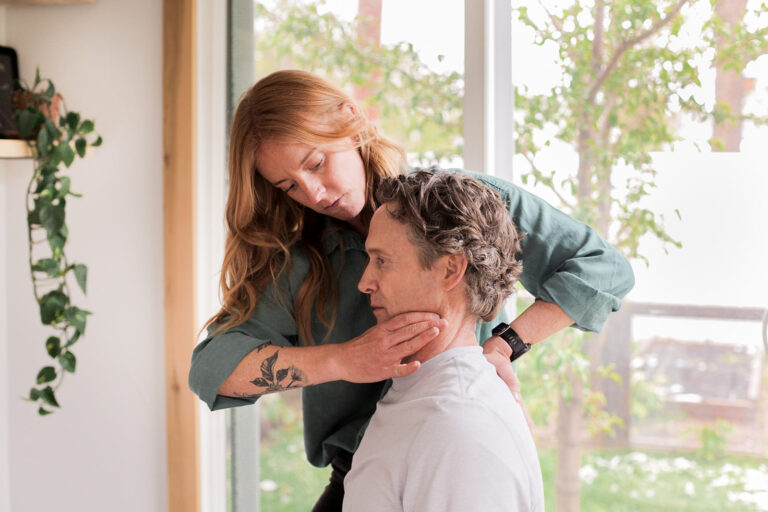
Neck pain and a pinched nerve are related questions, not identical ones
A sore neck does not by itself establish cervical radiculopathy. A clinician considers symptoms in the shoulder, arm or hand and relevant examination findings. Tingling in a finger does not reliably identify a disc level on its own. Our pinched-nerve guide explains the broader assessment.
How long does a cervical herniated disc take to recover?
Think in weeks to months, with regular reassessment rather than a fixed deadline. Your symptoms and daily function can improve on a different schedule from the MRI appearance. We follow arm symptoms, strength, sleep and everyday activity rather than waiting for a scan to look different.
Your useful milestones may arrive earlier than complete symptom resolution: less interrupted sleep, a shorter period of arm discomfort, or getting through part of the workday more comfortably. Progress should also include stable or improving neurological findings. Less pain does not cancel out new weakness.
For example, if desk work brings on arm symptoms, we compare the task with relevant movement and neurological findings. We can practice a more tolerable setup or selected movement, then check what happens afterward. Improving comfort is one checkpoint; new or increasing weakness needs medical review rather than automatic progression of exercise.
If you are not improving after several weeks, or symptoms are worsening, arrange a review rather than simply repeating the same program. You can ask for help sooner when pain is disrupting sleep, work or ordinary activity.
What can you do while deciding on care?
- Choose one daily goal. Examples are reading at the table, sleeping comfortably or turning to speak to someone. Write down what currently interrupts it. You do not need to repeatedly provoke symptoms to measure a baseline.
- Make the task more manageable. Break longer activities into shorter periods and change position regularly. Try supporting your forearms during seated work if that is comfortable. The aim is a tolerable setup, not holding a rigid “perfect” posture.
- Bring your current exercises. Record which version you tried, how often and what happened later. If a movement repeatedly spreads pain or tingling farther down the arm, stop that exercise and have the plan reviewed. Do not add force to make it work.
- Check the whole response. Notice the task afterward, later that day and the next morning. A brief reduction in pain is useful information; lasting function and neurological changes also matter.
There is no universal “C5–C6 exercise” chosen from a scan. If you have already been prescribed neck retraction, our McKenzie neck-exercise guide explains technique and response questions. It is an education resource, not a substitute for selecting a movement that fits you.
Hear Dr. Emily put imaging in context
In this video, Dr. Emily uses an overflowing-cup analogy: imaging, activity, sleep, stress and sensitivity can all be part of pain. The lesson is to connect a scan with the whole assessment. This is general pain education, not a diagnosis of a cervical disc problem. Watch on YouTube.
Should you choose PT, an injection or a surgical opinion?
PT is a reasonable early option for many people whose examination supports nonsurgical care. An injection may be considered to help manage difficult nerve-related pain. Surgery is a different decision based on neurological findings, persistent limitations and the problem a procedure would address. These options can be coordinated rather than treated as an all-or-nothing choice.
| Your situation | A useful next step | What to clarify |
|---|---|---|
| Pain limits sleep, work or activity, without urgent neurological changes | A clinical assessment and individualized nonsurgical care, which may include PT. | Which activity will we measure, what should I practice and when will we review? |
| Pain remains difficult despite an appropriate plan | Review the diagnosis, exercise response and medical options with your treating clinician. | Could medication or an injection help me participate in recovery? What benefit and risks apply to me? |
| Persistent disabling symptoms despite suitable nonsurgical care | A spine-specialist discussion about the specific diagnosis and reasonable alternatives. | What would surgery be intended to change, and what are its benefits, risks and recovery demands? |
| Progressive weakness, hand clumsiness, balance or walking changes | Prompt medical assessment; sudden neurological changes may require emergency care. | How urgent is the assessment? Do not wait to complete a routine PT course. |
The important question is what treatment would change for you. Bring the activity you cannot manage and any changes in strength or coordination, so the recommendation can be connected to your examination and goals.
What should you bring to a neck-pain consultation?
Bring your report, the movements or treatments you have tried, and one daily activity you want back. A useful conversation connects those details with an examination. This short preparation sheet helps you explain what is happening without having to interpret the scan yourself.
Prepare five notes about your neck and arm symptoms
- The decision you are facing. Write the proposed next step in ordinary words: a PT assessment, a medication discussion, an injection or a surgical consultation. If you were given a procedure name, bring the written recommendation so you can ask what it is intended to address.
- The activity that matters most. Choose something specific, such as reading at the kitchen table, getting through a work meeting or turning to check traffic. Describe what interrupts it and roughly when that happens during your usual day. You do not need to push into symptoms to create a test.
- What changed with previous care. List the actual exercise, position, medication or other treatment, what changed, and whether that change carried into the activity. Include an exercise that made symptoms spread farther down your arm, not just the one that briefly felt soothing.
- Any change in strength or coordination. Tell your clinician about new difficulty gripping, fastening buttons, balancing or walking. New or worsening neurological symptoms need medical assessment; completing this sheet or a routine PT course should not delay that conversation.
- The question you want answered. Try: “What findings support this option for me, what benefit should we look for, and when would we change course?” A recommendation is more useful when you understand both its purpose and its limits.
What does research say about surgery and nonsurgical neck care?
A 2025 study of two randomized trials included 180 people with disabling arm pain and confirmed cervical disc herniation or spondylosis. It compared neck surgery with a nonsurgical program involving physicians and physiotherapists. At 12 months, the disc-herniation trial favored surgery by 7.4 points on the 100-point Neck Disability Index; the study specified 15 points as its minimal important difference. The spondylosis trial did not find a statistically significant between-group difference.
Those group results do not establish that all PT programs match surgery or predict your outcome. They support asking about your particular diagnosis, examination and expected benefit. Keep questions about surgical timing with your medical team.
At Mindful Movement PT, Emily uses the activity you chose to connect the examination with a starting plan and its review. Bring what has and has not helped. If something remains uncertain, that belongs in the explanation too. Our neck movement guide can help you prepare questions about an exercise you have already been prescribed.
What would a first MMPT visit add?
Your first PT visit is 60 minutes, one-on-one with Dr. Emily Warren, DPT, Cert. MDT. Bring your MRI report, the exercises you have tried and the questions the scan has left you with. Emily wants to know what happens during a work period or an attempt to sleep, including where any arm symptoms travel. We connect your account and report with relevant movement and neurological findings, practice a starting plan and agree how to check whether it is helping the task you want back.
- Understand: discuss what has helped, what has not and what the examination suggests.
- Practice: work through the selected movement or exercise together, including the amount and what response to watch for.
- Review: agree when to compare your sleep, work or movement goal and relevant examination findings. Adjust the plan or seek another opinion when needed.
When should you seek urgent help?
Get urgent medical assessment for gradually worsening arm or leg weakness, clumsy hands, difficulty with balance, or changing sensation. Sudden new weakness, new difficulty walking, sudden loss of coordination, new bladder or bowel loss of control, or stroke-like symptoms require emergency care. Neck pain after significant trauma also needs medical assessment before self-treatment.
These changes are different from routine stiffness. Do not wait for an exercise review when new neurological symptoms need medical assessment.
Choose your next step
What would you like to do more comfortably: sleep, work, turn your head or return to exercise? Bring that goal and what you have already tried. We will help you understand the next useful step.
Local PT: work one-on-one with Dr. Emily Warren, DPT, Cert. MDT, at our Holladay clinic, serving the greater Salt Lake City, Utah area. Your first appointment is 60 minutes. No referral is needed.
Virtual health and wellness: get live help with movement education, exercise technique and building a routine you understand, from wherever you are.
We will reply by phone or text to arrange your Free Case Review. This request does not reserve a PT appointment.
Related help: neck PT in Holladay and Salt Lake City · neck pain after sleeping · neck pain when turning your head.