
Weight-bearing exercise for osteopenia: build strength with guidance
By Dr. Emily Warren, DPT, credentialed McKenzie therapist, BoneFit-trained | Mindful Movement PT, Salt Lake City, UT
One-on-one PT with Dr. Emily Warren, DPT, Cert. MDT. No referral needed. In-person care in Holladay, serving Greater Salt Lake City, and virtual coaching from anywhere.
An osteopenia result is an opportunity to review your bone health and take practical steps. We help you combine strength training, appropriate weight-bearing activity and balance work. You can begin from your current ability and build toward the activities you want to keep enjoying.
Osteopenia is a useful reason to take practical steps now. Your scan gives us part of the picture; your fracture history, symptoms, strength and balance help us choose exercise you can learn and progress. We want you to feel more capable, with a plan that fits your starting point.
This guide gives you the specific exercise categories, programming structure, and progression principles that evidence supports for building bone density when you have osteopenia.
DPT, Cert. MDT
Get a clear plan for stronger bones at your first visit with Dr. Emily
Emily’s early work in neurological rehabilitation shaped her interest in movement, pain and what people want to get back to.
Emily is BoneFit trained. Your fracture history, medical guidance, strength and balance help determine where to begin. She explains the purpose of each movement, watches your technique and helps you build a routine with a challenge appropriate for you.
Meet Emily and explore her approach · Request a Free Case Review to discuss how to feel stronger in the activities you enjoy.
Why Osteopenia Is the Best Time to Start
Understanding where osteopenia sits on the bone health spectrum clarifies why this stage represents such an opportunity:
- Normal bone density: strength, balance and an active routine support long-term bone health.
- Osteopenia: bone density is below the reference range but not in the osteoporosis T-score range. This does not by itself prove current bone loss or set a safe exercise intensity.
- Osteoporosis: your clinician considers bone density together with fractures and other risk factors. We adapt exercise to that full picture.
Many people with osteopenia can build toward challenging strength training. We select the starting movement and resistance through assessment, then progress with coaching rather than use the diagnosis alone to decide what you should lift or jump.
Starting a purposeful exercise routine gives you useful strength, movement and consistency goals now. Some people also see bone-density maintenance or improvement with appropriate training. Your medical clinician guides follow-up scanning and interprets the result.
Your story is the starting point
What do you want to feel stronger doing?
Your scan, fracture history and medical care help guide bone-health exercise. So do the things you enjoy and the movements that feel unfamiliar. Dr. Emily wants to understand that starting point with you.
Tell us what confidence would look like for you: carrying groceries, working in the garden, getting up from the floor or staying on the trails.
Exercise Category 1: Resistance Training
Progressive resistance training is the cornerstone of any osteopenia exercise program. The goal is to load the skeleton at magnitudes exceeding what your bones normally experience, triggering the adaptive response that builds new bone tissue.
Principles for Osteopenia
- Progression: choose resistance with your clinician or coach and increase it when technique, symptoms and your assessment support the next step.
- Site specificity: Focus on exercises that load the lumbar spine and femoral neck (hip), the sites most vulnerable to fracture
- Progressive overload: Systematically increase load over weeks and months
- Compound movements: Multi-joint exercises that create high total-body forces
- Frequency: 2-3 sessions per week with at least 48 hours between sessions for the same muscle groups
Priority Exercises
Deadlift Variations (Hip and Spine Loading)
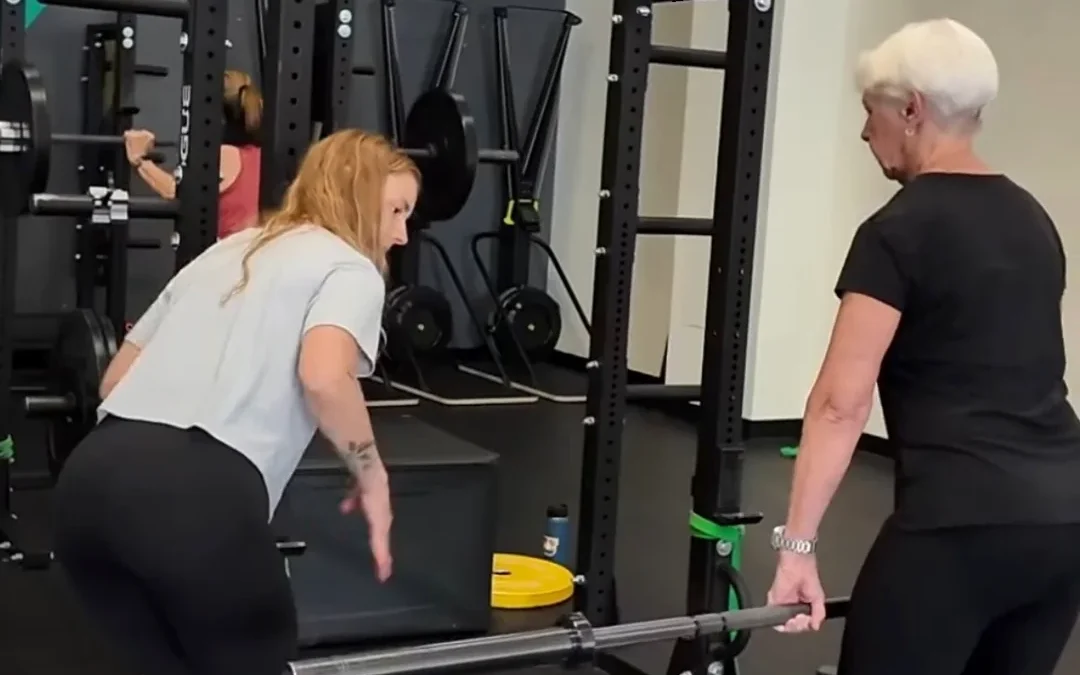
The deadlift is one way to load the hips and spine while building strength for lifting. We choose a variation and starting resistance around your ability, bone health and movement control.
Turn an exercise list into a plan you can practice
We help you learn the movements, choose an appropriate challenge and progress with support. Dr. Emily explains how that works in our small classes.
Why we keep our bone-strengthening classes small
Dr. Emily explains how we watch your movement, help you modify an exercise and progress it when you are ready. We want you to feel supported while doing enough work to build strength and confidence.
Key points from the video
- Dr. Emily keeps the strength classes small so she can watch technique and offer individual attention.
- Exercises can be modified when needed and progressed when someone is ready.
- The goal is enough challenge to build strength, support bone health and grow confidence.
- Beginner: Hip hinge with dowel, kettlebell deadlift, trap bar deadlift
- Intermediate: Conventional barbell deadlift, Romanian deadlift
- Advanced: Heavy conventional or sumo deadlift with resistance selected for your assessed ability and technique.
Squat Variations (Hip and Spine Loading)
Squats create axial loading through the spine and high compressive forces at the hip joint. Depth and external load determine the magnitude of skeletal stimulus.
- Beginner: Goblet squat, box squat, leg press
- Intermediate: Back squat, front squat
- Advanced: Heavy back squat with resistance selected for your assessed ability and technique.
Overhead Press (Spine Loading)
Standing overhead pressing creates axial compression through the entire spine and loads the shoulder girdle. It also challenges core stability and balance.
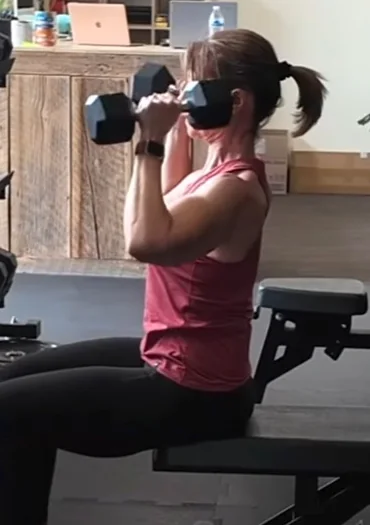
- Beginner: Seated dumbbell press, landmine press
- Intermediate: Standing barbell overhead press
- Advanced: Heavy standing press, push press
Rowing Movements (Spine and Posture)
Heavy rows load the spine and build the posterior musculature that maintains upright posture and counters thoracic kyphosis.
- Beginner: Seated cable row, dumbbell row
- Intermediate: Barbell bent-over row, chest-supported row
- Advanced: Heavy barbell rows, weighted pull-ups
Single-Leg Exercises (Hip Loading and Balance)
Unilateral exercises create high forces at the hip and simultaneously train the balance system.
- Beginner: Split squat, step-up to low box
- Intermediate: Walking lunge with dumbbells, Bulgarian split squat
- Advanced: Heavy lunges, single-leg Romanian deadlift with barbell
Exercise Category 2: Impact Training
Impact exercise can provide a different loading stimulus from resistance work. It is one option to consider, rather than a requirement for every person with osteopenia. We decide whether it fits your fracture history, balance and current ability, and coach an appropriate starting version.
Why Impact Matters
Impact exercise can provide a different loading stimulus from resistance work. We decide whether it belongs in your plan and teach an appropriate version; jumping and drop landings are not automatic starting exercises.
Impact Exercise Progression
Level 1: Low-Amplitude Impact
- Heel drops (rising onto toes, then dropping onto heels with force)
- Stomping (deliberate forceful foot strikes while standing)
- Marching in place with emphasis on foot strike
- Low step-downs with landing emphasis
Level 2: Moderate Impact
- Small jumps in place (1-2 inch height)
- Lateral hops
- Skipping
- Jump rope (low amplitude)
Level 3: High Impact
- Vertical jumps for maximum height
- Broad jumps
- Box jumps with step-down
- Drop landings from 4-8 inch height
- Multidirectional bounding
Impact Training Guidelines
Impact is one possible part of a bone-health program. We assess whether it fits your history and ability, teach an appropriate version and adjust the amount and progression to your response. Footwear, surface and exercise choice should support control and confidence; chasing the hardest landing is not the goal.
We choose whether impact exercise belongs in your plan and which version to practice. Your movement control, balance, symptoms, fracture history and medical guidance matter more than reaching a particular level by a fixed week.
Exercise Category 3: Balance Training
Resistance and suitable impact training can help support bone strength. Balance training helps reduce fall risk, so you can move more confidently as well. Falls are an important cause of fractures, but some fractures, especially vertebral fractures, happen without a fall. A useful plan addresses both bone health and the skills you use to stay steady.
Balance Training Components
These are examples we may choose from, rather than a checklist to try on your own. Begin with a stable support within reach. Eyes-closed practice, unstable surfaces and reactive drills need an appropriate setup and supervision when your balance or fracture risk makes a fall more likely.
Static Balance
- Single-leg stance (progress from eyes open to eyes closed)
- Tandem stance (heel to toe)
- Standing on unstable surfaces (foam pad, BOSU)
- Single-leg stance with head turns or arm movements
Dynamic Balance
- Tandem walking (heel to toe along a line)
- Lateral stepping over obstacles
- Walking with head turns
- Backward walking
- Quick direction changes
Reactive Balance
- Supervised reactive-balance practice, with a clinician controlling the challenge and guarding against a fall
- Catching and throwing while on one leg
- Quick stepping drills
- Agility ladder work
Balance Training Guidelines
- Frequency: Daily (can be integrated into daily routines)
- Duration: 10-15 minutes per day
- Progression: Change one challenge at a time, such as foot position or a reaching task, while keeping control and suitable support.
- Support: Keep a sturdy counter or rail within reach. Reduce support when your control and balance show you are ready, rather than relying on confidence alone.
Build a week you can maintain
A useful routine combines coached strength practice, suitable weight-bearing activity and balance work. The exercises and challenge should fit your assessment, experience and recovery. You can keep the walks and activities you enjoy around that routine.
Strong Bones Strength Class meets Tuesday and Thursday, noon–1 p.m., in Holladay. If individual assessment or learning the movements is the better first step, we can begin with one-on-one bone-health PT and help you build a home or gym plan.
Exercises to Modify or Avoid
A diagnosis or T-score alone does not tell us how hard you can train. Fracture history, symptoms, balance and the way you perform the movement matter too. We can often adapt an exercise so you keep building strength. For more examples, see our guide to exercise modifications with bone loss.
Movement patterns worth adapting
- Repeated or loaded end-range rounding: With osteoporosis or a vertebral-fracture history, we usually adapt exercises such as weighted toe touches and repeated crunches. A hip hinge or an appropriate trunk-strength exercise can meet the goal with a different loading pattern.
- Bending and twisting under load: We can teach you to keep a load close, turn with your feet when useful, and control the movement. Comfortable, controlled rotation is not automatically off limits.
- Fast or uncontrolled movement: Reduce the speed, range or resistance until you can repeat the movement well. The next step depends on your control and response.
What this means for you
You do not need a growing list of things to fear. A qualified bone-health professional can help you understand which adaptations matter for your fracture history and which activities you can keep enjoying.
How to Progress Safely
Bone is continually being remodeled. As an exercise becomes easier, gradually increasing the challenge can help you continue building strength and provide a meaningful loading stimulus. Progression can mean more resistance, better movement control or a more demanding variation; it does not mean adding weight every session.
Progress as your skill and readiness improve
We increase the challenge when you can repeat the movement with control, your symptoms support it and the next step fits your assessment. If you have missed training or something has changed, we adjust rather than force a fixed weekly increase. The goal is a routine you understand and can keep progressing.
LIFTMOR and BoneFit: How They Inform Your Exercise Plan
These names describe different things. You do not need to choose one or graduate from one to the other.
LIFTMOR: research on supervised strength and impact training
The LIFTMOR trial studied eight months of closely supervised training in screened postmenopausal women with low bone mass. Its bone-density, strength and function results give us a good reason to consider progressively challenging exercise. The trial protocol is not a starting prescription for everyone with osteopenia.
BoneFit: training for professionals who guide exercise
BoneFit is an education program for health and exercise professionals. It teaches exercise selection and adaptation for people with osteoporosis, including strength, balance and everyday movement. It is not a separate low-intensity treatment tier.
At Mindful Movement PT, Dr. Emily brings BoneFit training together with progressive strength-training principles. We consider your DEXA results, fracture history, balance, symptoms and experience, then help you learn a plan you can keep progressing.
Written by Dr. Emily Warren, DPT, credentialed McKenzie therapist
Dr. Emily is the owner of Mindful Movement PT in Salt Lake City. She is a credentialed McKenzie therapist. Learn about Dr. Emily’s credentials and clinical background, or explore how assessment, education and exercise guide care at Mindful Movement PT.
Start Your Evidence-Based Bone Health Program
Dr. Emily Warren (DPT, credentialed McKenzie therapist, BoneFit-trained) designs individualized bone health exercise programs based on your DEXA results, fracture risk, and fitness level.
What progress looked like in the LIFTMOR research
There is a measurable reason to train for bone health. In LIFTMOR, postmenopausal women with low bone mass completed eight months of supervised resistance and impact training. Average lumbar-spine bone density rose 2.9%, compared with a 1.2% decline with low-intensity home exercise. Strength and physical-function measures also improved. Read the trial.
We use this research to guide purposeful, progressive training with coaching, starting where you are. See the full results, including how many participants maintained or increased spine bone density.
Google review: Kathy T.
“Emily has been great at helping me with proper technique to get the most out of lifting…”
Frequently Asked Questions
My T-score is -1.2. Do I really need to worry about this?
An osteopenia result is a useful reason to review your overall fracture risk and exercise routine. A T-score does not predict a fixed timetable for future bone loss. We help you take practical steps now and track progress with your medical team.
Can exercise actually reverse osteopenia, or just slow the decline?
Exercise can help maintain or improve bone density, and some people may move out of the osteopenia range. Bone density is one sign of progress; strength, balance and confidence are others. In LIFTMOR, the supervised training group improved average lumbar-spine bone density over eight months. We also look at your strength, balance and everyday confidence, while your medical clinician interprets follow-up scans in context.
I have never lifted weights before. Can I still do this program safely at age 60?
You can learn strength training without previous gym experience. We begin with movement practice and a manageable resistance, then progress based on your technique and response. Your timetable is personal to you.
How do I know if my current exercise routine is enough for my bones?
A useful review asks whether the challenge is appropriate, whether technique is improving and whether the plan supports your daily activities. Scan results also depend on medical factors and measurement variability. We reassess the whole picture instead of judging a program from one number.
Serving Greater Salt Lake City — new appointments in Holladay
Holladay Clinic
4890 Highland Dr, Holladay, UT 84117
Near Cottonwood Heights & Millcreek
Serving Holladay, Salt Lake City, Sugar House, Millcreek, Cottonwood Heights, Murray, Sandy, Draper, Park City & surrounding communities. Virtual coaching appointments also available. 385-332-4939 |