
Dry Needling vs Acupuncture: An Honest Comparison
Dry needling and acupuncture both use fine needles, and some effects and treatment locations overlap. The main differences are the provider’s training, the assessment and how needling fits into care. If your goal is less pain and easier movement, the useful question is which approach fits your needs and gives you a clear plan for progress.
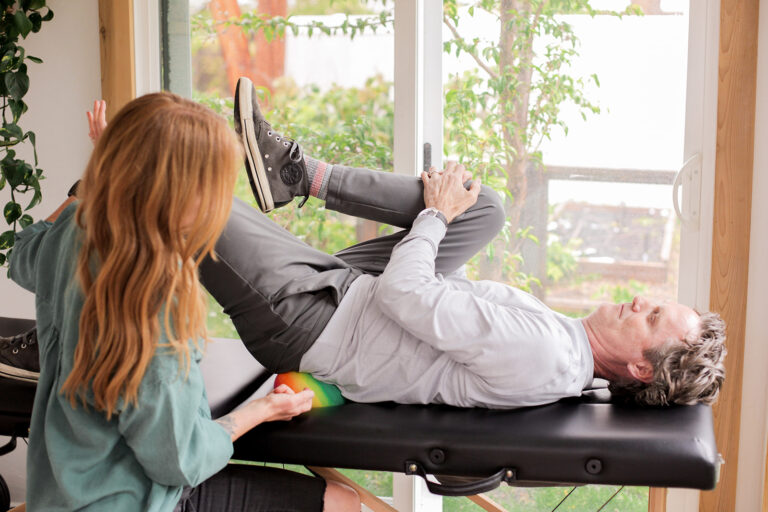
At Mindful Movement PT, we use dry needling within a physical therapy plan that can include McKenzie assessment for relevant spine problems, pain education, manual therapy and progressive exercise.
One-on-one care with Dr. Emily Warren, DPT, Cert. MDT. We offer in-person appointments in Holladay, serving Greater Salt Lake City. No referral is needed. Dry needling is an in-person treatment; virtual coaching from anywhere can support movement education and exercise. Request a Free Case Review
DPT, Cert. MDT
Get a clear plan at your first visit with Dr. Emily
Emily’s early work in neurological rehabilitation shaped her interest in movement, pain and what people want to get back to.
Emily discusses what you want dry needling to help you do and checks whether it fits the examination. If used, it supports a movement and exercise plan; the useful question is whether any relief carries into a task you care about, not simply how the muscles feel afterward.
Meet Emily and explore her approach · Request a Free Case Review to discuss how to connect pain relief with useful movement.
See dry needling in practice
This short social post from Dr. Emily shows dry needling with needles and electrical leads on the upper back and shoulder. Your assessment guides which approach fits your symptoms and goals.
What Is Dry Needling?
We use dry needling to help manage selected muscular pain and movement limitations. We choose the treatment area from your symptoms and physical examination and check how it affects a meaningful task.
How Dry Needling Works
A fine, solid needle is used in selected muscle or related tissue. “Dry” means no medication is injected. Needling can influence pain sensitivity and may make movement more comfortable; the effects are not fully explained by one simple muscle-reset mechanism.
A brief twitch response can occur, but it is not required as proof that treatment is effective. We assess the change in a movement or activity that matters to you rather than judging the session by the strength of a twitch.
What Does Dry Needling Feel Like?
You may feel a pinch, pressure, a deep ache or a brief muscle twitch. Temporary soreness can follow treatment. We explain what to expect, check your comfort and can pause or adjust. The useful response is better function and manageable symptoms, not more soreness.
What Is Acupuncture?
Acupuncture is a key component of Traditional Chinese Medicine (TCM) with a history spanning over 2,000 years. It involves inserting needles at specific points along the body’s meridians to influence the flow of qi (vital energy).
How Acupuncture Works (TCM Perspective)
According to TCM theory:
- The body has 12 primary meridians through which qi flows
- Illness and pain result from blocked or imbalanced qi
- Needle insertion at specific acupoints restores energy balance
- Treatment addresses the whole person, not just the symptom
How Acupuncture Works (Western Science Perspective)
Acupuncture may affect nervous-system activity, tissues near the needle and the broader experience of pain. Its mechanisms are not completely understood.
Acupuncture has roots in traditional Chinese medicine, but practice styles vary and some approaches also use modern anatomical and pain-science frameworks. It is too simple to say that all acupuncture is only about meridians or that none of its effects overlap with dry needling.
What Are the Key Differences Between Dry Needling and Acupuncture?
Training and Education
Physical therapists are licensed to assess and manage movement-related problems within their scope of practice. A PT who offers dry needling needs the additional training and qualifications required where they practice.
Licensed acupuncturists follow a separate professional education and licensing pathway centered on acupuncture. Exact requirements and practice permissions vary by jurisdiction.
Ask a provider about their license, relevant needling education, experience with your type of problem and how they handle risks. Dr. Emily Warren holds a DPT and Cert. MDT, her McKenzie credential. Cert. MDT describes Mechanical Diagnosis and Therapy; it is not a dry-needling certification.
Technique Differences
| Question | Dry needling in our PT care | Acupuncture |
|---|---|---|
| How are targets chosen? | From symptoms, examination and a movement-related goal. | From the practitioner’s assessment and acupuncture approach; styles vary. |
| What is the wider plan? | May include movement practice, strengthening, pain education and hands-on care. | May involve a course of acupuncture and other care within the provider’s scope. |
| Is one always deeper or stronger? | No. Needle depth, number, stimulation and time vary by area, technique and person. | |
| What should I ask? | What is the purpose, what are the risks, what alternatives do I have and how will we know it is helping? | |
Theoretical Framework
Dry needling in PT is selected within a musculoskeletal and movement assessment. Acupuncture developed within traditional Chinese medicine and now includes several clinical styles. Those histories help explain the terminology, but they do not by themselves settle effectiveness for an individual condition.
We focus on your goals, the evidence relevant to your problem and the plan beyond the needles.
Integration with Other Treatments
Our PT plan may include:
- McKenzie assessment and a selected home movement strategy for relevant back or neck presentations.
- Manual therapy when it helps comfortable movement.
- Progressive strength and functional exercise.
- Pain education and activity planning.
- Reassessment of the response and progression toward your goals.
Acupuncturists may also coordinate with other care providers. If you use both approaches, tell each clinician what you are having done so treatment and symptom responses can be understood together.
What Does the Evidence Say?
An honest comparison requires looking at the research for both:
Dry Needling Evidence
The evidence differs by condition and follow-up time. A 2023 umbrella review found short-term pain benefits overall, with less consistent functional outcomes and limited longer-term data.
That supports a possible role in symptom management, with a specific goal and reassessment. It does not show that needling is always better than exercise, manual therapy or acupuncture.
Acupuncture Evidence
Research supports potential benefits for selected pain conditions, including some back, neck and headache presentations. Results vary by condition and comparison treatment. Improvement compared with no treatment is often larger than improvement compared with sham procedures.
Evidence for acupuncture should not automatically be presented as evidence for dry needling. The techniques, dose, populations and clinical questions in the study matter.
The Honest Take
You do not have to choose based on a claim that one needling approach can fix everything. Ask which option fits your problem, your preferences and the activities you want back. We are happy to explain where PT and optional needling may help and where another assessment would be appropriate.
What Conditions Does Dr. Emily Treat with Dry Needling?
We may consider needling for muscular pain or guarding associated with neck pain, shoulder pain, hip pain, elbow pain, plantar heel pain and back pain. The specific assessment determines whether it belongs in your plan.
Headaches, jaw symptoms and nerve-related leg pain need their own assessment; a tender muscle does not explain every symptom. We discuss the possible muscular contribution without presenting needling as disc repair, nerve decompression or a cure for migraine.
Should You Choose Dry Needling or Acupuncture?
A PT assessment may be a useful starting point when:
- You want help understanding pain with movement, lifting, walking, sport or daily activities.
- You want needling considered alongside exercise and a home plan.
- You want to monitor strength, motion and functional progress, with referral when indicated.
- You are unsure whether the painful area is the only part that needs attention.
You may prefer to explore acupuncture when:
- You are interested in that approach and have a qualified provider to discuss suitability.
- You have benefited from acupuncture before and want to understand its role in your current care.
- You want information about acupuncture for a particular problem and the evidence relevant to it.
You can use both when appropriate. More treatment is not automatically better; agree on what each part is intended to contribute and how you will judge the overall result.
Experience Dry Needling at Mindful Movement PT
You receive dedicated one-on-one care with Dr. Emily Warren, DPT, Cert. MDT. At your first 60-minute appointment, we listen to what has been happening, examine relevant movement and explain a starting plan. If needling appears useful, we discuss it together; you can choose care without needles.
In-person appointments are in Holladay, serving Greater Salt Lake City. No referral is needed. Virtual coaching from anywhere can support movement education and wellness goals, but dry needling itself requires an in-person visit.
Google review: Alexander B.
“Emily is of course very knowledgable but I noticed that her super power was listening and understanding you.”
For preparation and practical questions, see our dry-needling FAQ.
Common questions
Is dry needling the same as acupuncture?
They share fine needles and some possible effects, but the professional training, assessment and treatment plan differ. We use dry needling within physical therapy and rehabilitation.
Do I have to choose needles to work with you?
No. We can build a plan using education, movement, strengthening and appropriate hands-on care without dry needling.
How will we know if treatment is helping?
We choose a relevant activity or movement to compare and review the carryover into your day. If function is not improving, we reassess the treatment mix.
Request your Free Case Review. We call you back the same day.
You do not have to know which treatment you need before reaching out. Tell us what has been bothering you, what you have tried and what you want to get back to. We can answer your questions and help you decide whether care with Dr. Emily feels like the right next step.
We will follow up by phone or text to arrange your Free Case Review. You can also call/text (385) 332-4939.